What if supply and demand had a third axis: time to clear?
This started with a question I could not quite let go of: if two sellers quote the same price, but one clears immediately and the other sits there for weeks, do we really have the same price signal? The more I thought about it, the more it seemed like textbook supply and demand leaves out one variable that matters in the real world: how long the market takes to agree.
Drafted August 2025 - Markets and decision quality - supply and demand, liquidity, price discovery, market microstructure
By David Beveridge Engineering leader, builder, and writer
Markets and decision qualitysupply and demandliquidityprice discovery
This is private exploration and general reflection, not financial, investment, tax, or legal advice.
The classical picture is clean. Price on one axis. Quantity on the other. Curves intersect, and that intersection stands in for equilibrium. That picture is useful, but it also flattens something that matters a lot once you move from theory to execution: a quoted price is not the same thing as an accepted price. Markets do not just reveal what something could clear at. They reveal how fast agreement shows up, and that speed carries information.
That is why I keep coming back to time-to-clear. Not because I think every economics textbook needs a dramatic rewrite, but because a lot of practical decisions already rely on a hidden third variable. A house listed for ninety days at one number is telling you something different from a house bid up in a weekend. A product that sells out instantly may be underpriced. A limit order that never fills may be advertising a fantasy rather than a market. The price alone is not the whole story.
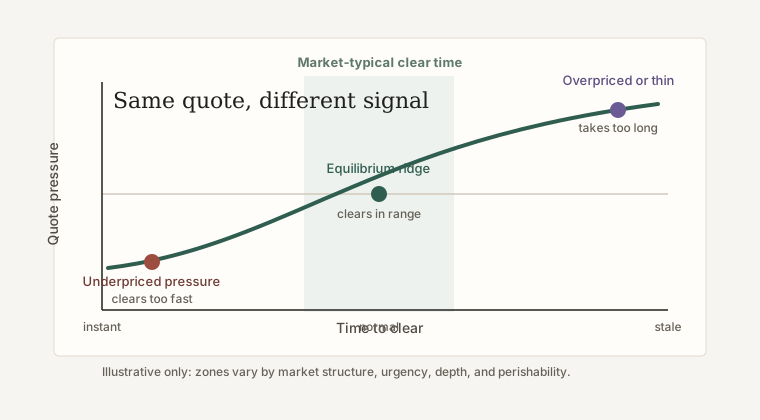
An illustrative version of the intuition. The useful signal is not just where price and quantity meet, but whether the quote clears too quickly, normally, or only after the market has had a long time to ignore it.
What time-to-clear is actually measuring
I do not think time-to-clear is a direct measure of value. It is closer to a measure of pricing confidence under real execution conditions. It tells you something about the distance between quoted price and executable price, filtered through liquidity, urgency, and market depth.
Observed outcome
What the raw price says
What time-to-clear adds
Sells almost instantly
There was a willing trade at that price.
The market may have been willing to pay more, or there was more urgency on the other side than the quote captured.
Takes a normal amount of time
A trade happened near the quoted level.
The price may be reasonably aligned with local market expectations and available liquidity.
Lingers for a long time
The seller wants that price.
The market may not agree, or the market is too thin to validate the quote quickly.
Never clears
The quote exists on paper.
The quote may be informationally weak, strategically placed, or simply not executable.
That is why the phrase "confidence interval of the pricing model" felt directionally right to me, even if I would probably refine the language. It is less about a formal statistical confidence interval and more about how much trust you should place in a price observation when the market had to strain, stall, or wait to produce it.
The interesting part is that slow and fast clears can both signal mispricing
The obvious use case is overpricing. If something takes a long time to sell, the intuitive conclusion is that the market does not like the number. That is often true. But the symmetric case may be just as important. If something disappears immediately, that can mean the listed price was too low relative to demand.
So time-to-clear does not just flag weak demand. It can also flag hidden surplus demand. In that sense, it helps distinguish three states that the raw price alone compresses:
State
Typical time-to-clear
Likely interpretation
Overpriced
Long
The quote is above what buyers will readily absorb.
Roughly aligned
Moderate and market-typical
The quote is close to where available supply and demand can meet without unusual friction.
Underpriced
Very short
The market accepted too quickly because the quote was more generous than necessary.
That symmetry is the part I like most. It turns time from a passive after-the-fact statistic into an active price-discovery signal. If the market is shouting "yes" too quickly, that can be as informative as the market slowly whispering "no."
A simple weighting model makes the intuition easier to use
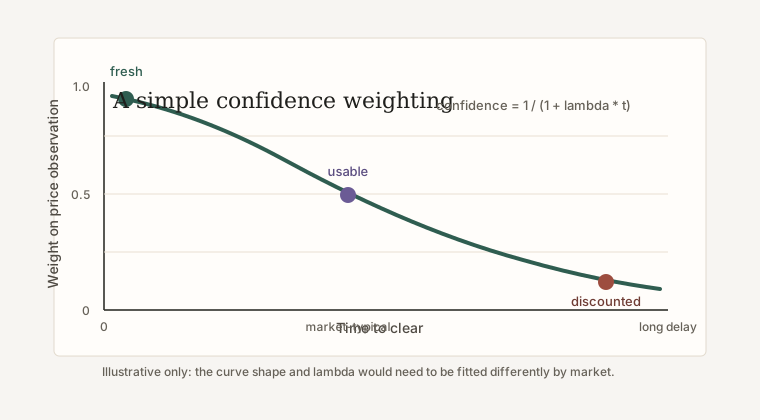
If I were sketching this into a practical model, I would not start by replacing supply and demand with a giant new theory. I would start smaller. Treat time-to-clear as a weight on how much confidence to place in a price observation.
The exact function does not matter much in this draft. The point is the posture. A price that clears immediately gets a heavier weight as evidence of live market agreement. A price that only clears after a long delay gets discounted, not because it is fake, but because it may reflect weak consensus, thin liquidity, or a seller asking for more patience than the market wants to offer.
One possible weighting shape. This is not a fitted empirical curve; it is a way to make the draft's modeling claim visible.
That suggests a more realistic mental model than a single equilibrium point. Instead of asking for one clean intersection, ask for a kind of equilibrium ridge: a region where prices clear in a market-typical amount of time, with long delays on one side and near-instant acceptance on the other.
Parts of this already exist in real pricing models
This is also why I do not think the idea is totally alien to existing practice. A lot of pricing systems already use time-to-clear, just not under that name and not inside the textbook supply-and-demand picture.
Revenue management already does this in a practical way. Airlines, hotels, and event pricing systems track booking velocity. If seats or rooms are disappearing too quickly, that is a clue the current price is too generous. If inventory is not moving, the system starts leaning the other direction. That is not a clean third axis on a classroom graph, but it is absolutely a timing signal being fed back into price.
Retail markdown and inventory planning do something similar. Sell-through rate, weeks of supply, and inventory aging are all ways of asking whether the sticker price is actually clearing inventory at the pace the business needs. Again, the raw posted price is not enough. The timing of demand changes how the price gets interpreted.
Market microstructure goes even further. Traders already care about fill probability, spread, queue position, time priority, and how much size can get done without moving the market. In that world, "price" has never really been just one number. It is price plus depth plus speed plus execution risk.
Where the idea still does not show up very well is in simpler models that treat price as a static label. A basic supply-and-demand graph, a cost-plus pricing rule, or a dashboard that reports average selling price without any velocity context can miss the whole issue. Those models can tell you what the quoted number was. They often cannot tell you how believable that number was under live market conditions.
Where this seems useful
I can see at least four settings where this extra dimension adds real clarity.
Real estate: days on market often tells you more than list price about how believable the list price really was.
E-commerce and retail: a seller can learn from how fast inventory clears, not just whether it clears.
Financial markets: the difference between visible price and executable size is already a microstructure problem, and time-to-fill is part of that story.
Policy and production analysis: supply responses often happen with lag, so a static price response can exaggerate short-run elasticity.
In all four cases, time helps separate nominal pricing from effective pricing. It forces the question: what could really transact, how quickly, and under what amount of friction?
Where the idea breaks if pushed too hard
I do not think time-to-clear should be treated as a universal mispricing detector. Sometimes a long wait means the item is overpriced. Sometimes it means the market is thin. Sometimes it means the seller is patient. Sometimes it means buyers are strategically waiting because they think conditions will improve. Perishable goods, luxury goods, commodities, and houses do not all carry the same timing logic.
That is the main caveat. Time is not pure signal. It is signal mixed with market structure.
So the stronger version of the idea is probably not "add time and the model is solved." It is "time-to-clear is one of the missing variables that tells you whether a quoted price is live, stale, urgent, thin, strategic, or genuinely consensus-backed." That is a more modest claim, but it is also more defensible.
This may be closer to market microstructure than to a rewritten supply curve
The more I worked through it, the more I suspected the real home for this idea is not a classroom graph with one extra axis. It is the broader world of price discovery, liquidity, and execution. In other words, the intuition is right, but the destination may be market microstructure rather than a prettier textbook diagram.
That does not make the intuition less useful. If anything, it makes it more operational. It shifts the question from "what is the equilibrium price?" to "how much market agreement exists at this price, and how quickly can that agreement actually be realized?"
Where I land for now
I do think price and quantity by themselves leave out something important. A market that clears instantly and a market that clears eventually are not saying the same thing, even when the nominal price matches. Time-to-clear is one way to expose that difference.
So my current read is that the third axis idea is worth keeping, but probably as a bridge concept. It is a way of noticing that price signals have different quality depending on how fast they become executable. In some contexts that will look like underpricing or overpricing. In others it will look like liquidity depth, urgency, or strategic waiting. Either way, it feels like a better question than pretending every observed price is equally real.
The next step, if I were pushing this further, would be to test it against actual market types rather than keep it at the metaphor level. Housing listings, marketplace inventory, and limit-order books probably each need a different version of the model. That is fine. The core idea still survives: time is not just background. It is part of the price signal.
Written by David Beveridge
Engineering leader and builder focused on product-platform architecture, technical strategy, and AI tools.