What would a 50-year mortgage actually do to housing affordability?
This started with a blunt question after seeing chatter about 50-year mortgages: if the U.S. ever normalized them, would that really make housing more affordable, or would it just move the pain around? The more I looked at it, the less I thought the interesting question was "would the monthly payment go down?" and the more I thought it was "who captures the benefit when you stretch housing debt that far?"
Drafted November 2025 - markets and decision quality - housing policy, mortgage markets, affordability, homebuilders
By David Beveridge Engineering leader, builder, and writer
Markets and decision qualityhousing policymortgage marketsaffordability
This is private exploration and general reflection, not financial, investment, tax, or legal advice.
My current read is that a 50-year mortgage would not solve the affordability problem in any deep sense. It would mostly repackage it. Monthly payments would come down some. Lifetime interest would explode. Equity would build painfully slowly. And because the payment screen is what drives qualification in so much of housing finance, a lot of the immediate benefit would likely get capitalized into higher home prices rather than permanently lower financial stress.
That matters because it means the question is still mostly hypothetical at the product level. But it is a useful hypothetical, because it exposes how housing affordability debates often work. We say "lower monthly payments" and our brains hear "problem solved." The system hears "bigger bid capacity."
The monthly-payment gain is real, but it is smaller than the headline sounds
For a clean illustration, I used Freddie Mac's April 30, 2026 average 30-year fixed mortgage rate of 6.30% and held that rate constant across both loan terms. That is actually generous to the 50-year case. In the real world, a 50-year product would likely carry a higher rate because the lender and investor are taking longer duration risk.
Even with that generous assumption, the payment drop is not magical.
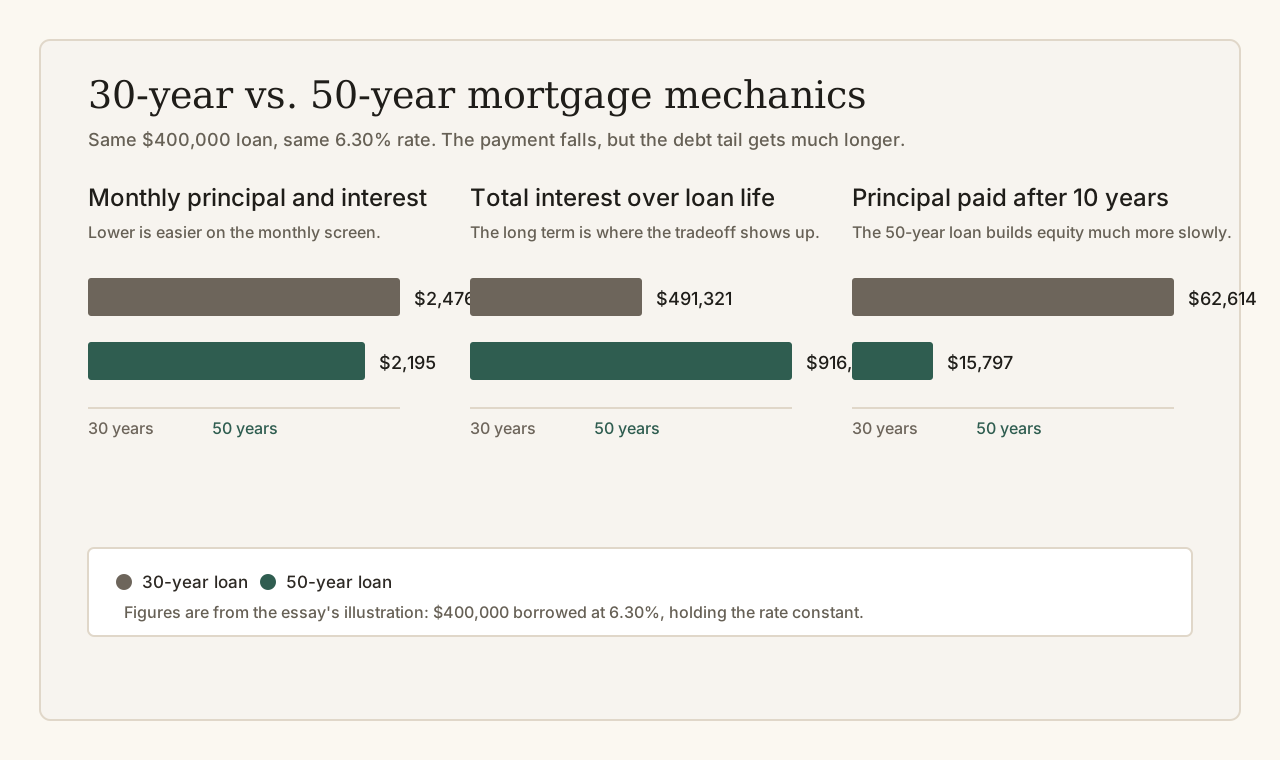
Same loan amount and rate as the table below. The 50-year term lowers the monthly payment, but lifetime interest rises and early equity builds much more slowly.
Scenario
Monthly principal and interest
Total interest over life of loan
Principal paid down after 10 years
$400,000 at 6.30% for 30 years
$2,476
$491,321
$62,614
$400,000 at 6.30% for 50 years
$2,195
$916,899
$15,797
So yes, the payment falls. But it falls by about $281 a month, while lifetime interest rises by roughly $425,578. More important to me, the first decade looks dramatically worse for equity formation. At the ten-year mark, the 30-year borrower in this example has paid down more than four times as much principal as the 50-year borrower.
That is the part I keep coming back to. A 50-year mortgage is not just a lower-payment mortgage. It is a radically slower-equity mortgage.
The bigger policy effect is probably bidding power, not durable affordability
Once you make the monthly payment the controlling variable, the next question is obvious: how much more house can someone bid for if the same payment is spread across fifty years instead of thirty?
Using the same 6.30% rate, the monthly payment that supports a $400,000 loan on a 30-year term would support about $451,222 on a 50-year term. That is roughly $51,222 more borrowing power from term extension alone.
Monthly-payment target
Loan amount supported at 30 years
Loan amount supported at 50 years
Extra bid capacity
About $2,476 per month
$400,000
$451,222
$51,222
That is why I do not think the cleanest frame is "this helps buyers." It helps buyers compete, at least temporarily. In supply-constrained markets, helping buyers compete often means helping sellers raise the clearing price. If a policy widens payment-based qualification without doing much for supply, it tends to get absorbed into asset prices.
That does not mean every market would react the same way. Local supply elasticity matters. Credit standards matter. Rate expectations matter. But the broad direction seems hard to escape: if you increase the amount of debt a household can carry for the same payment, the system has a strong tendency to convert that into higher house prices.
So who actually wins?
If I strip away the moral language and just ask who captures the economics, three buckets stand out.
First, mortgage originators and anyone paid on transaction volume. If lower visible payments pull more buyers into qualification ranges, origination volume and fee opportunities rise. They do not need the loan to be good for the borrower over fifty years to benefit at the front end.
Second, homebuilders and land-positioned housing suppliers. If payment-based qualification expands, new-home demand can absorb it quickly, especially in markets where builders can bring product online faster than existing-home supply can loosen. The gain does not have to show up as a perfectly clean unit-volume boom. It can show up as better pricing power, faster absorption, or firmer margins.
Third, servicing-heavy parts of the mortgage system. If mortgages stay outstanding longer and prepayment speeds slow, mortgage servicing rights become more interesting. That does not make this an easy trade. Mortgage finance is full of second-order effects and interest-rate risk. But structurally, a longer-lived loan can make the servicing cash-flow stream more valuable than it would be under a faster-turning 30-year book.
Who pays for it?
The obvious answer is the borrower, but the borrower is not the only one.
The borrower pays through slower equity formation, more total interest, and a longer period of life spent carrying housing debt. That matters on its own. A mortgage that follows deeper into middle age or retirement changes household resilience, not just monthly optics.
Future buyers pay too, because a term extension that raises bidding power can make the next purchase cycle more expensive. Housing policies that seem buyer-friendly in isolation often end up redistributing affordability across time rather than creating it from nowhere.
The broader financial system may also pay through duration complexity and policy distortion. Once government-backed channels normalize very long amortization, you are not just changing a consumer product. You are changing the shape of mortgage cash flows, prepayment assumptions, and the risk carried by institutions that fund, insure, buy, service, or hedge those loans.
How I would think about positioning without turning it into predatory finance
If I were trying to watch this as an investor rather than as a policy commentator, I would think in categories before I thought in tickers.
Mortgage originators and distributors if the main effect is transaction volume.
Builders, lot developers, and housing-input suppliers if the main effect is expanded payment-qualified demand.
Servicers and MSR-heavy businesses if the main effect is longer-lived mortgage cash flows.
I would be much more cautious about pretending this automatically creates a clean opportunity in long-duration mortgage paper itself. The instrument-level risk there gets messy quickly. Convexity, funding conditions, policy design, and rate volatility all matter. The higher-confidence version of the thesis is usually at the business-model layer: who earns more when housing debt lasts longer and more households can qualify on a payment basis?
I would also be careful not to confuse "would benefit if this policy happened" with "should be bought because the headline exists." That is where finance commentary often becomes sloppy. Mechanism first. Probability second. Valuation third. A thesis is not the same thing as a position.
My current read
My current read is that a 50-year mortgage is one of those ideas that looks pro-affordability only if you stop the analysis at the monthly payment. Once you follow the incentives farther, it starts to look more like a transfer mechanism: some relief on the payment screen, a lot more interest over time, slower equity accumulation, and a decent chance that a meaningful chunk of the benefit leaks into higher home prices.
That does not make the idea pointless to study. In fact, I think it makes it more worth studying. It is a clean example of how financial products can relieve one visible constraint while worsening the underlying system. If the real goal is durable affordability, supply and cost structure still matter more than finding a new way to stretch the debt tail.
Written by David Beveridge
Engineering leader and builder focused on product-platform architecture, technical strategy, and AI tools.