Monopoly, operational transforms, and the trustless system my kids abandoned
This started the way a lot of family Monopoly games start: somebody thought the bank balance was wrong, somebody else was sure a rent payment had already happened, and within a few minutes the argument was no longer about the game. So I did what any completely normal parent would do and tried to turn Monopoly into a tiny trustless system with a replayable ledger.
Drafted April 2026 - leadership and execution - Monopoly, parenting, trustless systems
By David Beveridge Engineering leader, builder, and writer
Leadership and executionMonopolyparentingtrustless systems
To be clear, this was not a high-stakes governance failure. This was kids fighting over Monopoly. Which is to say: it was a totally ordinary household problem, just with enough fake money and emotional certainty to make everyone sound like opposing counsel.
What I wanted was the smallest possible record-keeping system that could settle a dispute without relying on memory. Not a cute score sheet. Not a long narrative summary. A log. Something you could replay from top to bottom and use to reconstruct the game state when somebody inevitably said, "No, that's not what happened."
Once I looked at the problem that way, the board game stopped being the interesting part. The interesting part was the state. Who moved where? What changed hands? Which property got bought, mortgaged, or improved? If we could rebuild the state, we could settle the argument without asking the loudest person in the room to become the source of truth.
I accidentally taught Monopoly as a distributed systems problem
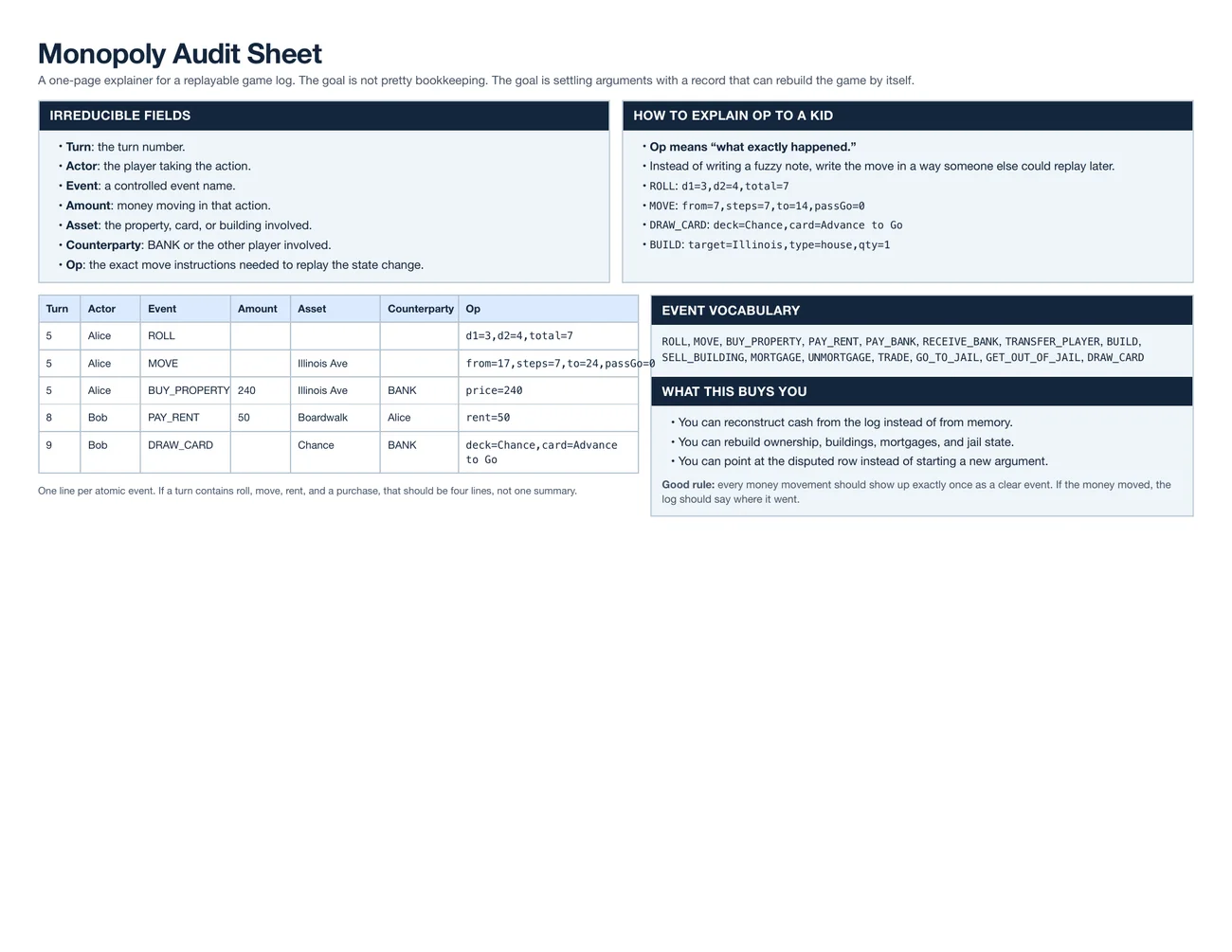
The trick was making the system irreducible. Household process usually gets worse when adults start adding more columns and more explanation in the name of seriousness. I wanted less. Each row needed only the turn, the player, the event, the amount, the asset, the counterparty, and one field for the exact operation payload.
That last field was the whole idea. A vague note helps someone remember what they meant. A reproducible operation lets someone else rebuild the state. "Moved to Illinois Avenue" is a memory aid. from=17,steps=7,to=24,passGo=0 is replay language. Once you start writing the game that way, you've basically stumbled into operational transforms for a board game.
That sounds ridiculous, but it was also surprisingly effective for a while. Instead of arguing about whether something probably happened, they could point to a line in the ledger. Instead of trying to remember the whole turn, they could check the atomic events: roll, move, pay rent, buy property, draw card, build house. The notebook stopped being commentary and started being an audit trail.
If you want the actual artifacts, I had ChatGPT turn the format into printable PDFs: a one-page Monopoly audit sheet and a matching blank replayable log. They're simple on purpose. The point wasn't to make the game feel official. The point was to answer a narrow design question: what is the smallest structure that makes the state trustworthy again?
A preview of the audit sheet. The downloadable PDF keeps the actual printable version.
Why a trustless system can actually help kids
I don't think kids need a ledger because they're uniquely dishonest. I think kids need a ledger for the same reason adults sometimes do: memory is messy, attention drifts, and once people feel wronged they start arguing about character instead of facts. A shared record can lower the temperature before a simple mistake turns into "you're cheating."
That's the part I still like. Sometimes the right answer is not "everybody calm down." Sometimes the right answer is better state management. A shared record gives everyone something outside themselves to point to. It changes the argument from motive to reconstruction.
That general lesson travels pretty well. Families hit it. Teams hit it. A flaky deploy, a spreadsheet with missing provenance, a product decision everyone remembers differently, a handoff nobody really documented. The problem isn't always broken trust in some big moral sense. Sometimes the problem is just missing replayability.
The funny part is that the system failed in the most predictable way possible
The system worked right up until it didn't. After about eight pages of ledger, everyone was tired of doing bookkeeping in the middle of Monopoly. The process started to feel like homework attached to a board game. At that point the trustless system became one more thing to resent.
And then we got the ending you'd expect. The logging slowed down, somebody stopped recording carefully, another person accused someone else of cheating, and suddenly we were back in the same argument all over again, except now with a half-maintained audit trail and even more indignation. It was very funny later. It was not especially funny in the moment.
I actually think that's the honest result, not a refutation. Every control system has an operating cost. A process can be correct, clarifying, and still too expensive for the job. Children just surface that truth faster than adults do. If the structure costs more than the benefit, they quit paying for it.
What I would keep if I did it again
I would still keep the design rule: if the disagreement depends on reconstructing state, build a log that can actually replay the state. I would keep the trust rule too: sometimes a lightweight system can stop normal confusion from turning into personal suspicion. And I'd definitely keep the cost rule: don't judge a process only by whether it works in theory. Judge it by whether real people will keep using it once the novelty wears off.
So no, the Monopoly ledger did not usher in permanent household peace. It bought some clarity, generated a lot of paper, and eventually collapsed under its own operational overhead. That's still useful. Better systems aren't the most elaborate systems. They're the ones that preserve enough truth to keep the game moving without becoming a second game nobody wanted to play.
Written by David Beveridge
Engineering leader and builder focused on product-platform architecture, technical strategy, and AI tools.